
Temple Honey
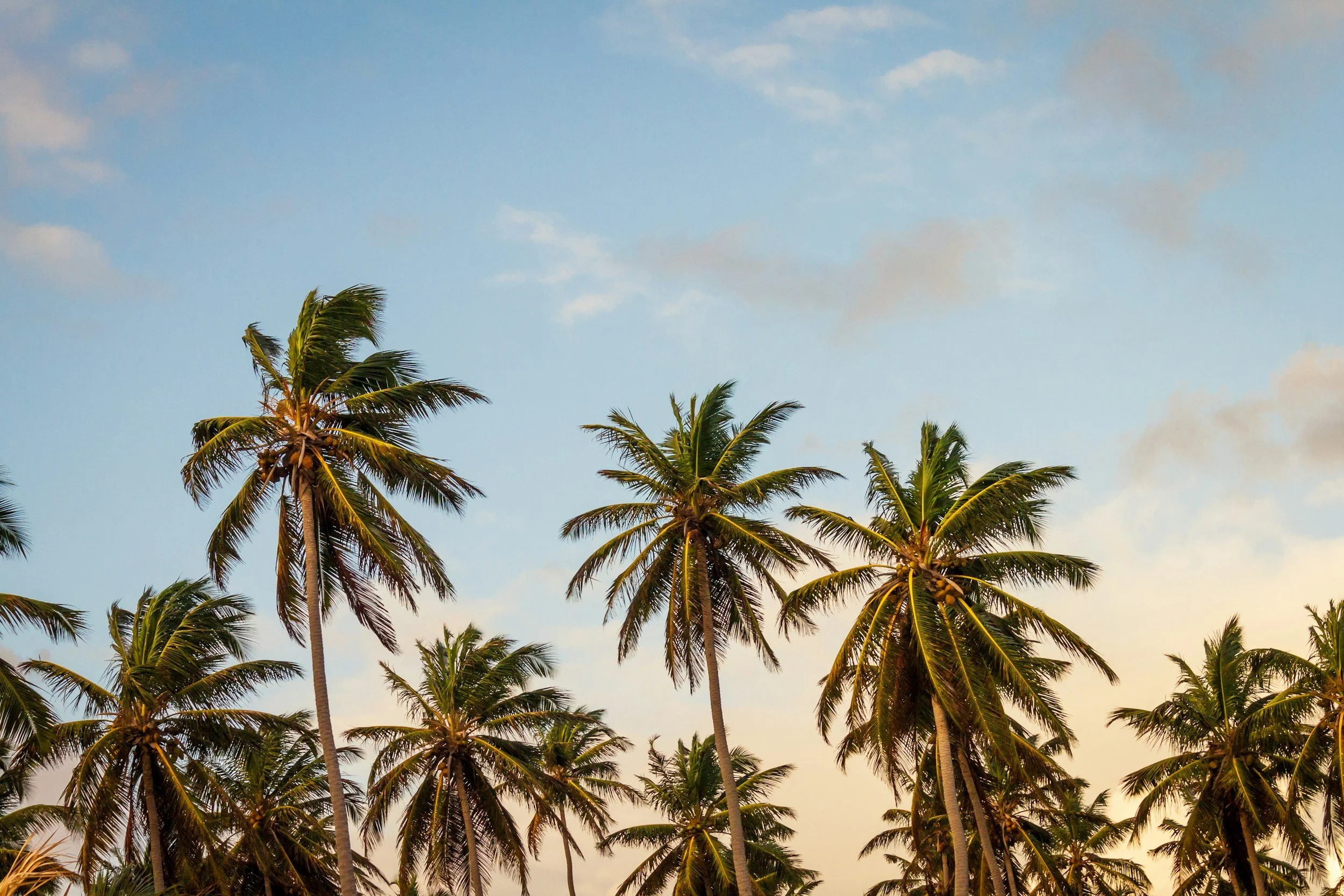
I walked through a grove of coconut trees
Each crowned atop with dark green leaves,
Rippling in the breeze from the Arabian Sea.
Then by the rocks I saw it perched,
The pink and white and gold little church.
It was a song that started it all, that led him to leave his job and travel five thousand miles from home. The song - as he thought of it, but which was more akin to a nursery rhyme or verse - set in motion a continent crossing search for something that he wasn’t even sure existed.
Barnsey was staying at the Amra Grove hotel in Kochi, India. It was Saturday 12th November, marking the second full week he’d been tracking down the location of the song. He'd visited several sites - all of them with apparent historical and spiritual significance; some were coastal churches, but they weren’t pink, and some pink that weren’t coastal - or even churches. He was aware that the colour of the building could have changed - as had been pointed out to him several times - but when he’d spoken to vicars, priests and other staff members, thought about the song and the images he associated with it - he knew none of them were it.
He was lingering over breakfast in the walled garden-restaurant of the small, quiet hotel. It had its own little waterfall which slipped into a bean-shaped lily pond. There were several butterflies, the occasional hummingbird and Barnsey watched as the hotel’s cat wandered between the tables. The serenity of the place was having the paradoxical effect of agitating him, reminding him of the lull in progress and the potential pointlessness of his journey. He’d been inexplicably drawn to what often felt like an eccentric and indulgent mission. The search was at an hiatus, and if he paused for too long, the tenuous, barely tangible reason of this entire trip could wisp into nothing.
The first church he visited - the oldest in the country - had a custodian who mentioned a derelict building overlooking the sea. Barnsey read through his notes on the laptop; it was near the coastal village of Koducherri and was rumoured to have been used as an early church, but the custodian emphasised that there was no historical record of this. More propitious options had overshadowed this avenue at the time, but it now held promise. He put Konducherri into his phone map and the village sprung up - less than ten miles away but with no church symbol nearby. He typed the name into his laptop and added church. Further down the search page his eyes halted at a news link entitled India’s Weirdest Villages . It was a sensationalist filler piece cataloging unexplained phenomena - Konducherri’s manifestation of weirdness was a slew of animal attacks upon its people, crops and buildings. Local folklore as well as modern conspiracies blamed the misfortunes on a cursed well, or - and this what garnered his attention - on the desecration of an ancient holy site. Barnsey collected his things.
The hotel receptionist was unable to secure a cab for at least another hour, and the taxi apps were coming up even longer than this. It was not the first time he’d regretted his choice of location. The trip had been booked hastily and his research had extended as far as the nicest hotels in the nicest region of the city, which didn’t disappoint on that front, but was the least convenient for travel. But he’d settled into the quirky charm and subdued buzz of the waterfront suburb - its winding streets, teeming with arts and craft shops, cafes and ‘colonial style’ hotels. The problem was that the drive to the mainland hub was unduly arduous - an already circuitous, heavily congested route along narrow roads and connecting bridges had now been slowed further by roadworks. The quickest way was the twenty minute ride on the little foot ferry.
Climbing onto the ferry, he remained outside leaning against the rail, putting his face into the breeze and watching the water despite himself. Once on the mainland, away from the cooler waterfront and on the main roads, the heat and noise of the broad city streets walloped him. Four lanes of mopeds, cars, bikes and auto-rickshaws rambled past, incessantly hooting to one another. He walked further along the street towards a mall, where the road narrowed to two lanes and a couple of auto-rickshaws were awaiting instruction.
It was September when he first remembered the song appearing in his head. He was in London, cycling into work, the deep gold light of autumn and the slight sharpness in the air, summoned a sense of new beginnings - instilled by years of life centered around academic calendars - although he’d been in the job for almost a year. His route led him past a park and then into a pack of fellow cycling commuters. After a few minutes of smooth onward flow, the cyclist directly in front suddenly breaked causing him to swerve into the curb, just missing a pedestrian and falling into the pavement. With no injuries, including the bike, Barnsey righted himself and pedalled on again. The rhyme with the pink church appeared in his head as he did so.
The next time he heard it was less dramatic, he was in the queue at his large local supermarket, hungry after a long day and impatient, keen to escape the glare of the white strip lighting. He watched a middle aged woman at the nearest tillpoint slowly blipping his items, at another, a man had double the amount of items recommended for the quick checkout. As he willed them to speed up, the song sauntered back into his mind.
The third time he noticed it, Barseny was at home alone one Friday evening, watching a limp thriller on TV. He switched it off halfway through, and started singing the words while checking his phone. He’d initially assumed the song was from childhood, with it came a stream of images; bright sunlight through tall tropical trees, deep blue waves rolling to the shore, and a building with sugar pink walls. His second assumption was that the images were formed from childhood imagination, and it didn’t garner more attention than that. It was when the song surfaced with increasing frequency that he paid more attention, and even then he ascribed it as a symptom of his creeping malaise. He was in a job he didn’t like and wasn’t very good at, his close friends were scattered in different cities or countries, and his university relationship had recently failed the long-distance test. Barnsey wondered if the song had come back to him as a self-soothing device, and evidence of a downward slump.
For an entire week in late September, his dreams became infused with the images from the song and each morning, for seven days in a row, he awoke to the verse playing in his head. It was as if the song had been fishing for him and he’d finally been caught. Either his mental state was in rapid decline, or something strange and impossible was happening. It was a Thursday and the seventh day of the dreams, when he emailed his manager to say he was sick and wouldn’t be coming in, and not budging from his bed, his search began. First, he googled the lyrics - utterly unrelated music videos sprung onto the pages. He then tried social media, forums, AI. None provided evidence that the song existed.
Next, he tried his family. He was an only child, his mother had died when he was a baby so he would have been too young to remember anything she might have sung. His father, although very much alive and well, he rarely saw. Barnsey had been raised by his father’s sister and her husband. When he messaged them asking if they had ever sung this verse to him, his aunt called him. She had never heard of it. What was the tune, she’d asked. He wasn’t sure, slow, sort of like a ballad he said, trying to sing it. She asked if it was okay, was he at work? He said he had to go.
He had two older cousins - Jemmy and Poppy; they were teenagers when the eight month old Barnsey came to join their unit. They had embraced his arrival, enveloped him, fussed over him then, as they did now, still delivering counsel that he no longer asked for. Shouldn't you be working? Jemmy, the eldest, had predictably responded.
Pink churches were next. Moving out of bed and into his kitchen he switched to the laptop and spent an inordinate amount of time finding photos of gaudy candy coloured structures across the world - many were in Vietnam and Thailand, they were also popular in Russian and Eastern Europe. They didn't match the mellow mood of the song that had been haunting him. He studied a map of the Arabian Sea - the list of countries which boarded it were Pakistan, India, Oman, Iran, Somalia as well as the Maldive and Laccadive archipelagos. When he put in a search for Arabian Sea and pink churches, only two places within one country provided results. He reluctantly called his father.
Barnesy’s full name was Barnabus Kurien Aitken. His middle name was of Indian origin, and had been given to him by his mother, who was part Indian - a half or quarter he was never sure, He waited for his father to pick up. It went to voicemail.
That Thursday night he drove home; his aunt and uncle hugged him, beaming - just a slight hint of concern in their eyes. He said he still wasn’t feeling well and went up to his bedroom. He took down a large box from a shelf, which contained some of his mother’s things There were framed photos; boxes of jewellery; some clothes, a letter to him that she’d written before she’d died, which he hadn’t read lately but knew verbatim, and there was no mention of coastal breezes or pink buildings. Like the rest of his family, she had no religious affiliation. At the bottom of the box were a few books - one was a travel guide to India. He flicked through it and a yellowed glossy page from a magazine fell out. The article was called “The Impossible Journey - The Mystery of Thomas the Apostle.” The article explored the theory - and local legend - that in 52 AD Thomas had sailed from Egypt, across the Abriabian sea to the Malabar Coast and had founded the first ever churches in India. Barnesy felt prickles rise up all over the back of his head.
Later that evening his father returned his call.
“No I don’t remember that song, but yes”, he confirmed, “her father, your grandfather, was from Kerala, although she’d never been and barely knew him. How’s the job going?”
Barnsey didn’t tell anyone that he was planning to quit his job and track down the location of the mystery song. When it came to it, he explained he was feeling stuck and wanted to travel whilst he still could. But they all deduced his main impetus anyway, and he received a torrent of opinions from family members: it’s a bit extreme; for what purpose; what he was expecting to find; bad idea to leave a good job; indulgent. did you invent this? His life seemed empty, and his finances were flourishing, (due to his absent father) and so he stuck to the plan. His uncle said it was a “beguiling mystery” to solve, and even if nothing comes of it, it was a good excuse to travel and find out about “the origins of the other side of you” as he put it. Four weeks later, Barnsey arrived in India.
He approached the rickshaw driver, a man in his forties wearing a tan shirt, faded jeans and a thick moustache. The driver shook his head at the request to drive out to the coast via the village“Too far”.
“I can pay extra”, Barsney said “Double?” The taciturn driver gave a quick nod and Barnsey climbed in.
After ten minutes of swerving and honking through the thick city traffic they reached quieter roads, zipping past vast open stretches of low green paddy fields, with coconut trees scattered along their verges. After another few minutes the landscape drew in, the road became cloistered with deep foliage and scattered buildings - the start of Konducherri. They passed a school, walled houses, shops and fruit vendors, before turning off onto a bumpy narrow road which eventually came to a cluster of around six identical houses. The houses were painted white and had dark brown window frames, and no sign of people - everyone was either inside or elsewhere.
Beyond the houses, was a blue rectangular building with a brass lantern in front of the doorway and a sculpture above it - the village temple. The driver stopped abruptly a few metres in front of the temple, shaking his head, claiming he could go no further, even though Barsney could clearly see the road continued on past the temple in the direction of the coast. Barnesy took out his wallet, offering more notes, but the driver had begun to reverse before he’d even stepped out. The little vehicle hastily hopped across the uneven road, kicking up orange dust as it zoomed away, and out of sight.
To the side of the temple was a round brick well - the well from the article, Barnsey wondered. It was plastered in black-green moss; he peered down into it. The dank walls dropped into the depths of the earth, so far down that all he could see was a distant blackness. He backed away, grateful for the rusty metal grill that covered the opening and walked over to the temple. Over the entrance the statue stared down at him, its painted face was graphite grey, a scarlet red tongue sticking out of its mouth. It was Kali- the Dark Mother - goddess of time, destroyer of evil, and as Barnsey stood in that desolate, lonely place, he remembered that she was also the goddess of death. His foot hovered briefly above the threshold before entering.
The cool dark chamber was an instant relief, the thick walls and the shutters kept out almost all of the light and heat of the searing sun. In the middle of the room was a traditional vilakku three foot tall brass lantern, with unlit wicks all around it. Watching Barnes as he moved further in, was another painted Kali statue, standing upright against the back wall. This time, Kali was full-bodied, her multiple arms fanning out, clutching a sword and severed head amongst other objects. To the right of the statue was a recessed wall, and in that, a closed polished wooden door. Barnsey could make out a humming sound, like a fan or fridge, emanating from the room behind it.
He knocked and said hello, hoping he might find someone to help with finding the abandoned church. After a second knock and a few more seconds, he pushed, and the door swung wide open. The room was an office, sparse with stark white walls. A metal desk was near the back wall, below a small high window. A few shelves were fixed to the far side, with a battered filing cabinet beneath. The room smelled of honey and something else. Similar to over-ripe bananas. Inside the hum became louder and more erratic, but the fan on the ceiling was still.
The shelves were stacked with a few Hindu texts, a couple of battered novels, and a framed picture of a building. Barnes strode straight over and picked it up. It was a church, the photo had faded, heat marks had ruined it, it could be pink but it was hard to tell. He stuffed it into his bag, it was too strange a coincidence to find a picture like that here - in a Hindu temple of all places.
The desk had a pot of pens, a couple of notebooks, and a newspaper in Malayalam script. There was something else in the middle of the desk that made his mouth turn dry. He reached out for it, unable to understand what he was seeing. On the desk was a photo - of him.
The hum transformed into a frenetic buzzing. It confused him momentarily, as if it were related to his shock discovery of the photo. He forced his eyes away from the desk and to the source of the sound. Behind the door in the corner of the ceiling was a dark vibrating mass. Hundreds of bees were hovering around a cavity that went into the roof. A hive. Barnesey had read that when threatened bees emit an odour similar to over-ripe bananas. Several shouts came from outside.
"Sir, Sir get out, bees!!!”
Grabbing the photo, he ran out, a few bees already heading towards him, and shut the door. Outside the temple, were two boys aged around twelve years old, they were similarly dressed in jeans, striped polo shirts and sandals.
“Sir, don’t go there, the bees, the hive.”
“I know”, Barnsey said, rubbing his arm - he hadn’t escaped completely unscathed. “Who’s office is that?”
“The priest used it.” the slightly taller and rounder of them said.
“Where is he? I need to speak to him.” The same boy looked down.
“The bees got him”, said the small one. “He’s dead”
“Oh. Oh no, that’s terrible.” Barnesy said, wondering why the hive hadn’t been removed. Glancing back at the temple the window to the office was shut, but the place was far from being sealed off. Perhaps everyone in the region knew about the hive, and outsiders like Barnsey weren’t expected.
“I’m really sorry about the priest. Did he live here? Do you know his name?”
“No, not from here. He was Pradeep Shanthi.” said the smaller of the two.
Barnsey took out his phone to make a note, “Could you spell that?”
“Actually his full name was P.A. Pradeep. Pulikkal Anandan Pradeep." The taller boy spelled it out for him.
“That’s great, thank you both. I came here to find a church or an old building, I think it’s around here, nearer to the shore. Do you know?”
“The road behind the temple goes to the sea.”
“Oh great, great, thank you. But is there a church, a pink church?”
The boys looked at Barnesy and shrugged as if to say, we have no idea.